PEOs, SOs, and Annual Student Enrolment and Graduation Data
Program Educational Objectives (PEOs)
1. Excel in Professional Roles – Attain impactful positions in cybersecurity and cloud computing industries, contributing to national and global digital security.
2. Lead and Innovate – Drive technological advancements, entrepreneurship, and strategic decision-making in cybersecurity and cloud computing.
3. Advance Research and Development – Contribute to scientific knowledge and technological solutions through research, innovation, and industry collaborations.
4. Engage in Lifelong Learning – Pursue professional certifications, advanced degrees, and continuous skill development to adapt to evolving global challenges.
5. Serve and Strengthen Communities – Promote cybersecurity awareness, mentor future professionals, and support industry and societal initiatives for a safer digital ecosystem.
Students Outcomes (SOs)
Student Outcome (SO)
Description
SO1
Analyze a complex computing problem and to apply principles of computing and other relevant disciplines to identify solutions.
SO2
Design, implement, and evaluate a computing-based solution to meet a given set of computing requirements in the context of the program’s discipline.
SO3
Communicate effectively in a variety of professional contexts.
SO4
Recognize professional responsibilities and make informed judgments in computing practice based on legal and ethical principles.
SO5
Function effectively as a member or leader of a team engaged in activities appropriate to the program’s discipline.
SO6
Apply security principles and practices to maintain operations in the presence of risks and threats.
SO7
Engage in continuous learning and research to contribute to the global advancement of the discipline.
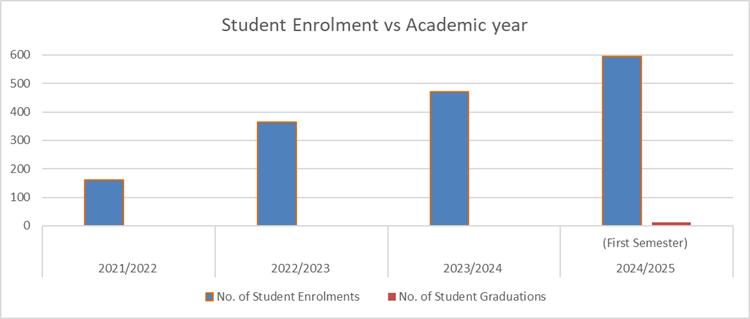
Annual Student Enrolment and Graduation Data
Academic Year
2021/2022
2022/2023
2023/2024
2024/2025
No. of Student Enrolments
162
364
471
594
No. of Student Graduations
-
-
--
12
Curriculum Details
Course (Department, Number, Title)List all courses in the program by term starting with first term of the first year and ending with the last term of the final year.
Indicate Whether Course is Required, Elective or a Selected Elective by an R, an E or an SE.1
Subject Area (Credit Hours)
Math & Sciences2
Computing Topics Mark with an F or A for Fundamental or Advanced
General Education
Other
First Semester – First Year
1401124 Communication skills (English 1)
R
3
1301106 Structured Programming
R
3 (F)
1501167 Discrete Structures (1)
R
3
1501110 Calculus (1)
R
3
University Elective Course
E
3
Second Semester – First Year
1401150 National Education
R
3
1301108 Object-Oriented Programming (1)
R
3 (F)
1307103 Linear Algebra
R
3
1501212 Probability and Statistics
R
3
1305101 Introduction to Cybersecurity
R
3(F)
Course (Department, Number, Title)List all courses in the program by term starting with first term of the first year and ending with the last term of the final year.
Indicate Whether Course is Required, Elective or a Selected Elective by an R, an E or an SE.1
Subject Area (Credit Hours)
Math & Sciences2
Computing Topics Mark with an F or A for Fundamental or Advanced
General Education
Other
First Semester – Second Year
1401123 Communication skills (Arabic 1) *
R
3
1301203 Data Structures and Algorithms
R
3 (F)
1302211 Technical Writing and Communication Skills
R
3
1305330 Data Communications and Computer Networks
R
3 (F)
1305202 Ethical and Professional Issues in Computing
R
3 (F)
1301236 Web-based Programming
R
3 (F)
Second Semester – Second Year
100103 Military Sciences
R
3
1305211 Principles of Cloud Computing
R
3 (F)
1305212 Network Security
R
3 (A)
1501230 Numerical Analysis
R
3
1305226 Operating Systems for Cybersecurity
R
3 (F)
1301305 Database and Application of Database
R
3 (F)
Course (Department, Number, Title)List all courses in the program by term starting with first term of the first year and ending with the last term of the final year.
Indicate Whether Course is Required, Elective or a Selected Elective by an R, an E or an SE.1
Subject Area (Credit Hours)
Math & Sciences2
Computing Topics Mark with an F or A for Fundamental or Advanced
General Education
Other
First Semester – Third Year
1305302 Advanced Cloud Computing
R
3 (A)
1305311 Infrastructure Security Using Linux
R
3 (A)
1305316 Cybersecurity Programming
R
3 (A)
1305383 Software Analysis and Design for Cybersecurity
Course (Department, Number, Title) List all courses in the program by term starting with first term of the first year and ending with the last term of the final year.
Indicate Whether Course is Required, Elective or a Selected Elective by an R, an E or an SE.1
Subject Area (Credit Hours)
Math & Sciences2
Computing Topics Mark with an F or A for Fundamental or Advanced
General Education
Other
First Semester – Fourth Year
1305368 Field Training
R
0 (A)
1305491 Graduation Project (1)
R
1 (F)
1302338 Advanced Internet Computing
R
3 (A)
1305404 Digital Forensics
R
3 (A)
1305401 Penetration Testing
R
3 (A)
Department Elective Course
SE
3 (A)
University Elective Course
E
3
Second Semester – Fourth Year
1305492 Graduation Project (2)
R
2 (A)
1305403 Data Analytics in Cybersecurity and Cloud Computing
R
3 (A)
1401116 Islamic Education
R
3
1305419 Risk Management and Vulnerability Analysis
R
3 (A)
Department Elective Course
SE
3 (A)
TOTALS-ABET BASIC-LEVEL REQUIREMENTS
15
87
30
0
OVERALL TOTAL CREDIT HOURS FOR COMPLETION OF PROGRAM
132
Continuous Improvement Process
Advisory Board and Stakeholder Input
– Industry Program Advisory Board (IPAB):
The Industry Program Advisory Board (IPAB) consists of key stakeholders who provide valuable insights into the program’s effectiveness and alignment with industry needs. The board primarily includes two main constituencies:
1- Alumni : To assess the long-term impact of the program and ensure continuous improvement, alumni surveys are conducted at specific intervals—one, five, and ten years post-graduation. These surveys help maintain updated alumni records and collect feedback on how well the program prepared them for their careers. As graduates of the program, alumni serve as direct indicators of the achievement of the Program Educational Objectives (PEOs), reflecting their professional growth, leadership roles, ethical practices, and ability to adapt to evolving cybersecurity challenges.
2- Employers : Employer feedback is gathered through surveys distributed alongside alumni surveys, targeting the supervisors of program graduates. Additionally, feedback is solicited from employers who may not yet employ program alumni but are actively engaged in the cybersecurity field. Employers consistently seek graduates who demonstrate strong technical expertise, effective communication skills, leadership in team environments, commitment to lifelong learning, and adaptability to emerging cybersecurity threats. These competencies are directly addressed in the program’s PEOs, ensuring that graduates meet industry expectations and remain competitive in the workforce.
Through the ongoing collaboration with IPAB, the program continuously refines its curriculum and learning outcomes to stay aligned with industry trends and stakeholder needs.


 العربية